Newsletter EU ETS Maritime
|
|
|
|
| |
|
|
Dutch Emissions Authority ETS Maritime webinar 22 January |
|
|
|
|
Due to the new compliance year for MRV, EU-ETS and Fuel EU Maritime, the Dutch Emissions Authority (NEa) will host a webinar about Monitoring Plan validation, ETS Maritime, the Union Registry, Fuel EU Maritime and Biofuels on Thursday 22 January 10:00 – 11:30 (CET, GMT+1).
The focus of this webinar is to provide an overview of important deadlines, changes in policy and answers to frequently received questions during the last year. Topics will include the year-end closing for EU-ETS, the surrendering of EUAs, opening of MOHAs, EU MRV monitoring plans, Fuel EU Maritime and biofuels. The webinar will end with a Q&A session, during which you can ask your questions live to the Dutch Emissions Authority.
A link to the webinar will be provided a few days beforehand.
|
|
|
|
|
|
Dutch Emissions Authority has published a MRV MP guidance document |
|
|
|
|
Following questions from shipping companies about feedback received on their monitoring plans (MPs), the NEa has developed a guidance document. This guidance document supports shipping companies in creating EU MRV monitoring plans for their vessels; it contains guidance on specific procedures, common issues and solutions, and a FAQ.
Consult this guidance when revising your MP to increase the likelihood of your MP being approved. The document can be downloaded here.
If you have multiple vessels in your fleet, you will receive feedback on a ‘leading’ MP. After resubmission the NEa will once more assess the MP, and after approval, all other MPs can be revised using this approved ‘leading’ MP as a template. Of course you should keep in mind that the MP should reflect the actual situation on each ship. |
|
|
|
|
|
Year-end closing: EU-ETS Maritime
|
|
|
|
|
Year-end closing compliance 2024
2025 marked the first year in which shipping companies were obliged to pay for the (CO2) emissions (in the 2024 calendar year). This first compliance year is widely regarded as an overall success: the European Commission reported 99% of the (grand total) emission allowances surrendered, according to data from the Union Registry. The Dutch Emissions Authority looked closer into the Registry numbers for shipping companies attributed to the Netherlands in a press release that can be found here.
Year-end closing 2025: changes and important deadlines
The upcoming year, 2026, will be the second year in which shipping companies are to comply with MRV/ETS obligations for emissions emitted in the year before. Due to the phase-in nature of the EU Emissions Trading System in the maritime sector, there are some changes to this legislation as compared to the first compliance year, which are:
- Shipping companies have to surrender allowances for a portion of their emissions during an initial phase-in period. In 2026, this is 70% of the 2025 emissions reported, while in 2025 this was 40% of the 2024 emissions reported.
- Though there certainly were consequences for not reporting emissions and/or surrendering sufficient EUAs, 2025 was widely regarded as a ‘starting’ year; the Dutch Emissions Authority focused on compliance assistance over enforcement. This will change in 2026 where we will shift from compliance assistance towards enforcement. This is because we expect shipping companies to have obtained experience with reporting and allowance surrendering during the first compliance year, which will allow them to meet the deadlines more accurately this year. Notwithstanding the Dutch Emissions Authority still seeks to provide guidance to facilitate shipping companies in being compliant to EU-ETS regulations.
Important obligations and deadlines in 2025 are:
| Obligation |
Deadline |
System |
| Submit a satisfactorily verified emissions report for each ship |
31 March 2026 |
THETIS MRV |
| Submit a satisfactorily verified aggregated emissions report per company |
31 March 2026 |
THETIS MRV |
| Enter the verified emissions figures |
31 March 2026 |
EU ETS registry |
| Have the emissions figures in the registry confirmed by your verifier |
31 March 2026 |
EU ETS registry |
| Surrender the equivalent number of allowances |
30 September 2026 |
EU ETS registry |
|
|
|
|
| |
|
Deadline FuelEU Report 31 January 2026
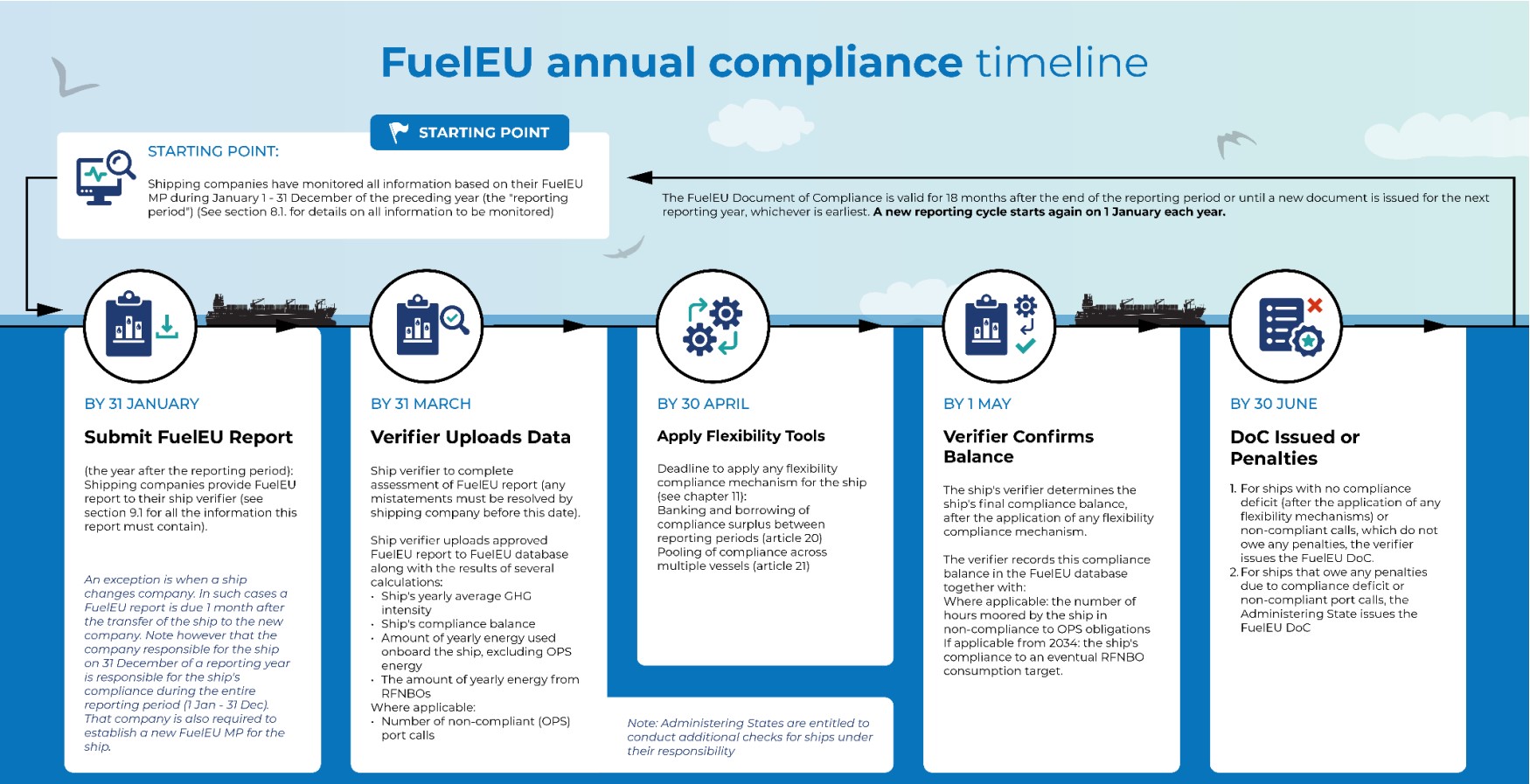
According to THETIS-MRV, your shipping company is subject to the first FuelEU Maritime compliance cycle, for which The Dutch Emissions Authority (NEa) is your Administering State in The Netherlands. The first deadline in the compliance cycle is 31 January 2026, by which you must submit your FuelEU Report to your verifier in THETIS-MRV. Please ensure you have appointed a verifier and that you check your credentials for THETIS-MRV to avoid any last minute login issues.
See the image below for a visual overview of the FuelEU annual compliance cycle. |
|
|
|
| |
|
Source: Guidance document by the European Commission (Figure 7.2, page 77)
This is an overview of your FuelEU obligations and deadlines in 2025:
| Obligation |
Deadline |
System |
| Submit your FuelEU report to your verifier |
31 January 2026 |
THETIS MRV |
| Apply flexibility mechanisms |
30 April 2026 |
THETIS MRV |
| Pay FuelEU penalty (in case of compliance deficit) |
30 June 2026 |
CJIB |
FuelEU Penalty collection process
In case of a negative compliance balance by 1 June 2026, the NEa as your Administering State, will calculate and issue the FuelEU penalty due to be paid by your shipping company. The NEa has subcontracted the collection of this fine to the CJIB. The CJIB is an implementing agency that forms part of the Ministry of Security and Justice and enforces fines and other measures and ensures that any imposed penalties are collected swiftly and efficiently.
In case of a negative compliance balance you will receive a letter from the CJIB indicating the penalty amount and the payment instructions on where to remit this sum by the deadline of June 30th. If the penalty is remitted on time and the proof of payment is uploaded on THETIS-MRV, the NEa will issue the FuelEU document of compliance (DoC) in the FuelEU database.
New guidance document on the FuelEU Maritime Regulation published
The European Commission has prepared a new extensive guidance document on the FuelEU Maritime Regulation, which is published here.
National implementation
The FuelEU Maritime Implementation Act has been published. The Act outlines, among other things, the competences of the Dutch Emissions Authority and the applicable penalty provisions in The Netherlands.
More information and guidance
More information on the FuelEU Maritime Regulation can be found on our website, or on the website of the European Commission. |
|
|
|
| |
|
Demonstration of sustainability and GHG savings criteria of lower GHG intensity fuels
Shipping companies, if they meet the necessary requirements, can claim a zero-rating of CO2 emissions from sustainable biomass under the EU ETS and/or report the use for the GHG reduction requirement under FuelEU Maritime.
Initially, compliance to RED criteria can be demonstrated through a Proof of Sustainability (PoS). In cases where a fuel supplier is not able to provide the PoS to the shipping company — because of RED obligations — there are two options for shipping companies to still be able to prove compliance:
- Through a Proof of Compliance (PoC) issued by a certified fuel supplier.
- Through the national temporary solution that facilitates parallel claims of renewable energy in The Netherlands. In this case, your fuel suppliers need to submit additional data when registering a fuel delivery in our national registry under their RED obligation. This measure only applies to situations where shipping companies have bunkered biofuels supplied from Dutch fuel suppliers attributed to the NEa.
More information on these options can be found on our dedicated webpage.
BDN issuance in relation to blended fuels
The NEa received several signals from the industry about the practice by bunker suppliers who, at request of the shipping companies, issue two separate Bunker Delivery Notes (BDNs)—one for the fossil share and one for the biofuel share—when a single blended fuel (e.g. B30) is supplied. The intended aim of this practice is to optimize the MRV fuel reporting on incoming voyages when using blended fuels.
The practice of multiple BDN issuance is not permitted under MARPOL Annex VI and will not be accepted for MRV reporting. When a blend is used, the different pure fractions shall be meant to be consumed, for each voyage, in accordance with their pro-rata contribution to the blend mass. It is not possible to diverge from this by allocating a single fraction of the blend to a specific portion of the voyage.
Please refer to the recently updated MRV Guidance document for additional guidance. |
|
|
|
|
|
Where to find more information? |
|
|
|
| |
|
|
|